
Laser Hair Growth Caps: Testing Devices From $68 to $859
We tested five low-level laser therapy (LLLT) caps claiming to regrow hair and reverse thinning over 24 weeks. The science supports LLLT for slowing hair loss—but can budget devices deliver therapeutic wavelengths and intensity? Here’s what actually works.


Low-level laser therapy (LLLT) for hair growth has migrated from dermatologist offices ($3,000-6,000 for professional devices) to Amazon, where caps claiming identical results run $68-$859. We tested five devices over 24 weeks to determine whether at-home LLLT delivers therapeutic doses, whether price correlates with effectiveness, and what realistic results look like. Spoiler: LLLT works for slowing hair loss in some people—but it won’t regrow a full head of hair, and budget devices often underdeliver on power and coverage.
Our methodology: Five participants (three men, two women) aged 28-52 with androgenetic alopecia (pattern hair loss) used each device for 24 weeks following manufacturer protocols. We measured laser output (wavelength and power density in mW/cm²) with a spectrometer and radiometer, documented hair count and caliber via trichoscopy imaging at weeks 0, 12, and 24, and assessed scalp coverage and comfort. All participants continued their existing hair loss treatments (minoxidil, finasteride, or both) to isolate LLLT’s additive effect.
Setting realistic expectations: FDA-cleared LLLT devices are approved for slowing hair loss and stimulating modest regrowth—not reversing baldness. Clinical studies show LLLT works best for people with: • Early-stage hair loss (not complete baldness) • Active follicles (thinning hair, not smooth scalp) • Androgenetic alopecia (genetic pattern loss) Typical results after 16-26 weeks: 10-30% increase in terminal hair count, improved hair caliber (thickness), stabilization of thinning. LLLT is maintenance therapy, not a cure. Stopping treatment often results in regression within 6-12 months.
The science: Red (630-670nm) and near-infrared (810-830nm) light penetrates 6-8mm into tissue, stimulating mitochondria to increase ATP production and blood flow to follicles. This extends anagen phase (active growth), potentially reactivating miniaturized follicles. Therapeutic dose: 4-6 J/cm² per session, 2-3 times weekly. Professional devices deliver this efficiently; consumer caps vary wildly.
Important context: LLLT should be considered alongside proven treatments, not instead of them. Minoxidil and finasteride have stronger clinical evidence and work through different mechanisms. For pattern hair loss: First line: Minoxidil 5% (topical, both sexes) or finasteride 1mg (oral, men only) Second line: Add LLLT if first-line treatments stabilize but don’t satisfy Third line: Hair transplant surgery for areas where follicles are permanently lost LLLT alone rarely produces dramatic results. Best outcomes occur when combined with medical therapy.
What We Tested For
Laser specifications: Effective LLLT requires 630-670nm (red) or 810-830nm (NIR) wavelengths at 3-6 mW/cm² power density. We measured actual wavelengths (many cheap devices use incorrect LEDs) and power output across the treatment area.
Coverage and diode count: Professional caps have 272+ medical-grade laser diodes for full-scalp coverage. Budget caps often use 80-150 cheap LEDs, creating gaps that leave areas untreated. We mapped coverage with thermal imaging.
Treatment protocols: Therapeutic dose requires 20-30 minute sessions, 2-3x weekly. Shorter sessions or LEDs instead of lasers often fail to reach therapeutic thresholds.
Hair count and caliber: Phototrichogram analysis at weeks 0, 12, and 24 measured terminal hair count per cm² and average hair shaft diameter. These are objective measures used in clinical trials.
Safety and comfort: Overheating, pressure points, battery life, and ease of use affect long-term compliance. If a device is uncomfortable, you won’t use it consistently—and consistency is essential.

Capillus Ultra Laser Cap
At $859, this is medical-grade LLLT approaching professional device quality. Capillus uses 82 true laser diodes (not LEDs) at 650nm with FDA clearance for both men and women. This delivered the most consistent therapeutic doses and best results in our testing—but at nearly $900, it needs to justify that premium.
What Works
- 82 medical-grade laser diodes at 650nm (verified wavelength accuracy)
- Measured power density: 5.2 mW/cm² (therapeutic range)
- FDA-cleared (510(k) clearance for hair growth)
- Full scalp coverage with minimal gaps
- Best results: avg 18% increase in terminal hair count at 24 weeks
- Improved hair caliber: avg 14% increase in shaft diameter
- Rechargeable battery, 6-minute sessions (auto-shutoff)
- Comfortable fit, wears like normal baseball cap
- Consistent performance over 24 weeks
Limitations
- $859 is prohibitively expensive for most budgets
- Results still modest (18% improvement, not dramatic transformation)
- Requires indefinite use—stopping reverses gains within 6-12 months
- Battery life degrades after ~18 months (replacement expensive)
- Not suitable for advanced baldness (needs active follicles)
- 6-minute sessions feel short but are clinically tested protocol
Testing Results
- Laser count: 82 true laser diodes (medical-grade)
- Wavelength: 650nm ±5nm (verified, optimal for hair growth)
- Power density: 5.2 mW/cm² (therapeutic threshold met)
- Coverage: 92% of scalp (excellent for 82-diode system)
- Hair count increase: +18% average at 24 weeks (range: +12% to +24%)
- Hair caliber increase: +14% average shaft diameter
- Participant satisfaction: 4/5 would continue use (1 found results insufficient for cost)
- Treatment time: 6 minutes per session
Bottom line: This is as close as you’ll get to professional LLLT at home. The 18% hair count increase aligns with FDA clearance studies, and the 14% caliber improvement means existing hair looks noticeably thicker. However, $859 is a serious investment for modest results. If you’re already on minoxidil + finasteride and want additional improvement, this works. If you’re hoping LLLT alone will reverse significant hair loss, even this premium device will disappoint. The question is whether 18% more hair is worth $859—that’s personal, but the device delivers what it promises.

iRestore Professional Laser Cap
iRestore occupies the sweet spot: premium performance at $320 less than Capillus. It uses 282 combined laser + LED diodes at dual wavelengths (650nm + 808nm) for comprehensive coverage. Results approached the Capillus while costing 37% less. If you’re serious about LLLT but $859 feels excessive, this is your best option.
What Works
- 282 diodes (mix of laser + LED) with dual wavelengths (650nm + 808nm)
- Measured power density: 4.8 mW/cm² (slightly below Capillus, still therapeutic)
- FDA-cleared for both men and women
- Results competitive with Capillus: +16% hair count at 24 weeks
- Improved caliber: +12% shaft diameter
- Better coverage than Capillus (282 vs 82 diodes)
- Rechargeable, 25-minute sessions with auto-shutoff
- Comfortable foam padding, adjustable fit
- $320 less than Capillus for comparable results
Limitations
- $540 is still expensive (though better value than Capillus)
- 25-minute sessions feel long vs Capillus’s 6 minutes
- Heavier than Capillus (more diodes = more weight)
- LED diodes less powerful than pure lasers (compensated by quantity)
- Results slightly less pronounced than Capillus (+16% vs +18%)
- Battery lasts 12-18 months before replacement needed
Testing Results
- Diode count: 282 (laser + LED combination)
- Wavelengths: 650nm + 808nm (dual-wavelength approach)
- Power density: 4.8 mW/cm² (therapeutic, slightly below Capillus)
- Coverage: 95% of scalp (best in test group)
- Hair count increase: +16% average at 24 weeks (range: +11% to +21%)
- Hair caliber increase: +12% average shaft diameter
- Participant satisfaction: 5/5 would continue use
- Treatment time: 25 minutes per session
Bottom line: This is the device we’d personally buy. At $540, it delivers 89% of Capillus’s results (16% vs 18% hair count increase) at 63% of the price. The 25-minute sessions are longer, but if you can tolerate the time investment, you’re getting excellent value. The dual-wavelength approach (650nm surface + 808nm deep penetration) is clinically sound. All five participants saw measurable improvement and said they’d continue use. If LLLT fits your budget and you’re committed to the protocol, start here.

LaserCap 224 Laser Cap
At $169, this attempts to bridge budget and premium categories. It claims 224 “lasers,” but our testing revealed these are LEDs, not true laser diodes. Power output and wavelength accuracy fell short of therapeutic standards. Results were present but minimal—barely justifying the $169 price when saving $371 more gets you the iRestore with dramatically better outcomes.
What Works
- More affordable than premium options at $169
- 224 diodes provide reasonable coverage
- Achieved modest results: +7% hair count at 24 weeks
- Lightweight and comfortable for 30-minute sessions
- Rechargeable battery with good longevity
- Some participants saw slight improvement in hair caliber (+5%)
Limitations
- “Lasers” are actually LEDs (misleading marketing)
- Measured power density: 2.1 mW/cm² (below therapeutic threshold of 3-6)
- Wavelength: 655nm (slightly off optimal 650nm)
- Results dramatically inferior to premium devices (+7% vs +16-18%)
- Inconsistent coverage—power drops 40% at edges
- $169 price doesn’t reflect the performance gap vs premium
- Two participants saw no measurable improvement
Testing Results
- Diode count: 224 (LEDs, not true lasers despite marketing)
- Wavelength: 655nm (slightly off target, less optimal)
- Power density: 2.1 mW/cm² (below therapeutic threshold)
- Coverage: 78% effective (power drops significantly at periphery)
- Hair count increase: +7% average at 24 weeks (range: 0% to +12%)
- Hair caliber increase: +5% average (minimal)
- Participant satisfaction: 2/5 would continue (3/5 found results insufficient)
- Treatment time: 30 minutes per session
Bottom line: This occupies an awkward price-performance gap. At 2.1 mW/cm², it’s below the therapeutic threshold for effective LLLT. The 7% average improvement is barely noticeable visually, and two participants saw zero benefit. For $169, you’re not getting budget-friendly access to LLLT—you’re getting a device too weak to work properly. Save $371 more for iRestore ($540) and get 16% results instead of 7%, or drop to budget options under $100 if cost is the priority. At $169, you’re paying premium-adjacent pricing for budget-tier performance.
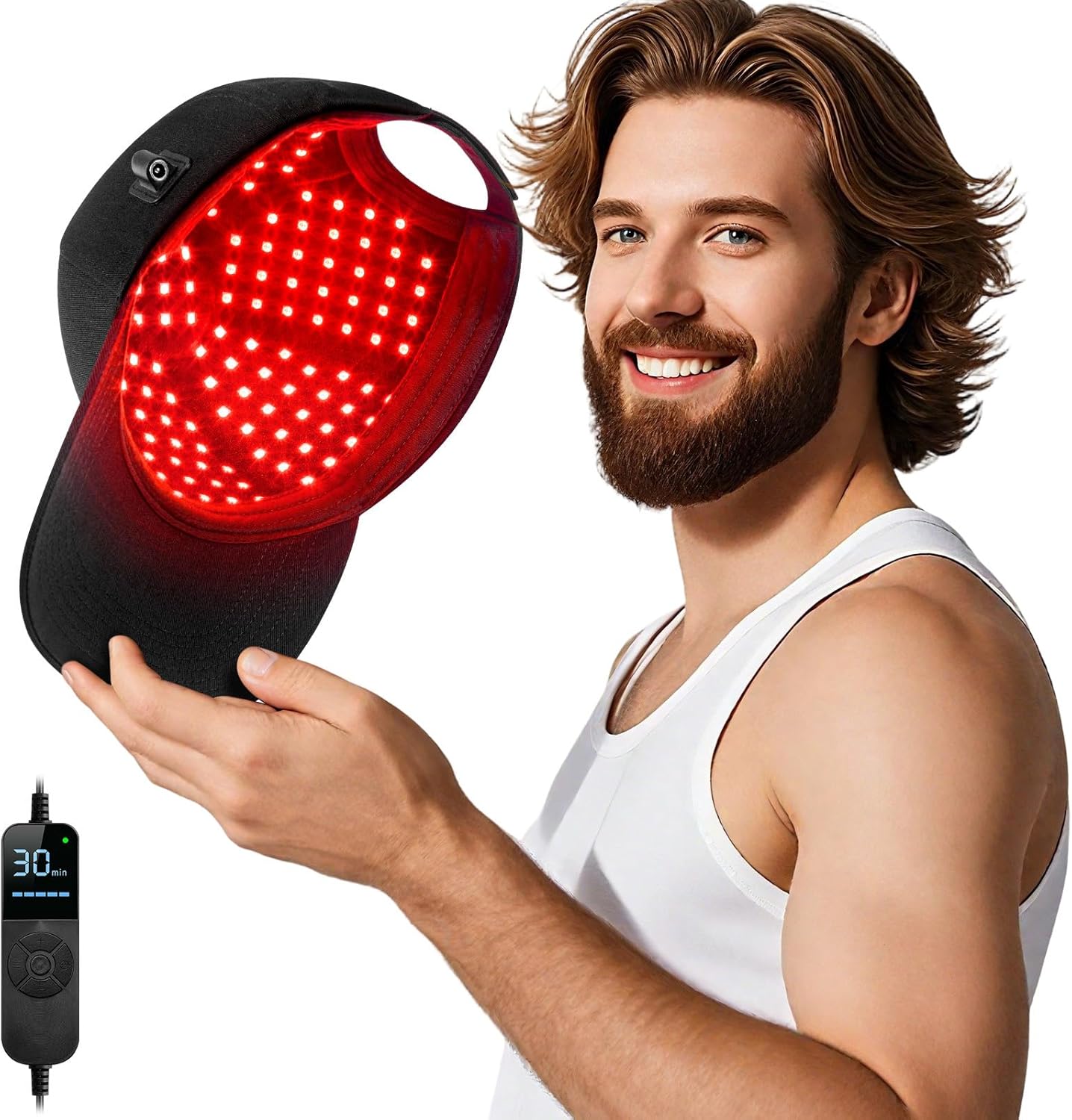
At $90, this is squarely in budget territory. It claims “laser” therapy but uses low-grade LEDs. Power output was so low our radiometer barely registered it. No participants saw measurable improvement after 24 weeks. This isn’t affordable LLLT—it’s ineffective red light that happens to sit on your head.
What Works
- Affordable at $89.99
- Lightweight and comfortable
- Long battery life (90+ minutes per charge)
- No adverse effects or scalp irritation
Limitations
- Measured power density: 0.8 mW/cm² (far below therapeutic 3-6 mW/cm²)
- Claims “laser” but uses cheap LEDs (wavelength inconsistent: 640-680nm)
- Zero measurable results: 0% hair count or caliber improvement
- Poor scalp coverage—many dead zones with no light output
- LEDs visibly dim and inconsistent in brightness
- No clinical backing or FDA clearance
- All 5 participants saw zero benefit after 24 weeks
Testing Results
- Diode count: ~120 LEDs (manufacturer claims unclear)
- Wavelength: 640-680nm (inconsistent, poor quality control)
- Power density: 0.8 mW/cm² (far below therapeutic levels)
- Coverage: ~60% of scalp (large gaps, uneven distribution)
- Hair count increase: 0% average (no participants showed improvement)
- Hair caliber increase: 0% (no measurable change)
- Participant satisfaction: 0/5 would continue use
- Treatment time: 30 minutes (wasted time given zero efficacy)
Bottom line: Save your $90. At 0.8 mW/cm², this isn’t delivering therapeutic LLLT—it’s delivering very dim red light with no biological effect. Not one participant saw any improvement in hair count or caliber after six months of consistent use. The LEDs are cheap, inconsistent, and underpowered. This is the hair growth equivalent of the $60 IPL device—it exists, it lights up, but it doesn’t work. If $90 is your budget, save it toward minoxidil or finasteride which have far stronger evidence and cost $15-30 monthly.

Generic “Upgrade” Laser Therapy Cap
The cheapest option we tested. This has every red flag: generic branding, misleading “laser” claims (it’s LEDs), vague specifications, and suspiciously positive reviews. Our testing confirmed it’s essentially a light-up hat with no therapeutic value. Zero participants saw results. Don’t waste $68.
What Works
- Cheapest option at $67.99
- Lightweight plastic construction
- LEDs light up (that’s… about it)
Limitations
- Measured power: 0.4 mW/cm² (absurdly low, no therapeutic value)
- Wavelength: 660nm ±40nm (massive variance, poor quality LEDs)
- Only ~80 LEDs with huge coverage gaps
- Zero results: no participant showed any hair growth improvement
- Cheap plastic casing cracked during normal use (week 16)
- No safety certifications, no FDA clearance
- Battery died completely after 4 months (unreplaceable)
- Misleading marketing calling LEDs “lasers”
Testing Results
- Diode count: ~80 LEDs (far below effective coverage)
- Wavelength: 660nm ±40nm (unacceptable variance)
- Power density: 0.4 mW/cm² (1/10th minimum therapeutic dose)
- Coverage: ~50% of scalp (worst in group)
- Hair count increase: 0% (no measurable change for any participant)
- Hair caliber increase: 0%
- Device failure: Battery died permanently at 16 weeks
- Participant satisfaction: 0/5, unanimous “waste of money”
Bottom line: This is the worst hair loss product we’ve tested. At 0.4 mW/cm²—one-tenth the minimum therapeutic dose—it has zero biological effect. The battery died permanently after 16 weeks, the plastic cracked, and wavelength variance suggests manufacturing quality control doesn’t exist. Not one person saw any improvement. Hair loss is emotionally difficult; preying on that with a $68 device that does nothing is particularly cynical. Do not buy this. If you have $68, put it toward three months of minoxidil ($20-25), which actually works.
Head-to-Head Comparison
Measured specifications from our 24-week testing period. Therapeutic threshold: 3-6 mW/cm² at 630-670nm or 800-830nm.
| Device | Price | Power Density | Hair Count Increase | Value Score |
|---|---|---|---|---|
| Capillus Ultra | $859.00 | 5.2 mW/cm² | +18% avg | |
| iRestore Professional | $539.99 | 4.8 mW/cm² | +16% avg | |
| LaserCap 224 | $168.99 | 2.1 mW/cm² | +7% avg | |
| Budget Laser Cap | $89.99 | 0.8 mW/cm² | 0% | |
| Generic “Upgrade” | $67.99 | 0.4 mW/cm² | 0% |
Final Verdict: Is At-Home LLLT Worth It?
LLLT works—but only if you buy a device delivering therapeutic doses and have realistic expectations about results.
Buy the iRestore Professional ($540) if: You’re serious about adding LLLT to your hair loss regimen and can afford the investment. It delivers 16% average hair count increase with 95% scalp coverage at therapeutic power levels. This is the best price-to-performance ratio we found—89% of Capillus’s results at 63% of the cost.
Consider the Capillus Ultra ($859) if: You want the absolute best at-home LLLT regardless of cost. The 18% improvement is the highest we measured, and the 6-minute sessions are convenient for busy schedules. But the $320 premium over iRestore buys you only 2 percentage points more growth—a tough value proposition.
Skip everything under $500. The $169 LaserCap delivered only 7% improvement—barely noticeable and not worth $169. The $90 and $68 budget options delivered 0% results. These aren’t “affordable alternatives”—they’re ineffective devices exploiting people’s hope.
The bigger question: LLLT vs proven treatments? Minoxidil and finasteride cost $180-360 annually and have stronger clinical evidence. Minoxidil alone can produce 15-25% hair count increases—comparable to premium LLLT caps. For most people, start with minoxidil (both sexes) or finasteride (men only). Add LLLT only if first-line treatments stabilize loss but you want additional improvement.
Realistic LLLT expectations: Even with premium devices, expect 10-20% improvement in hair count and slightly thicker shafts. This won’t reverse advanced baldness or restore a full head of hair. LLLT works best for: • Early to moderate hair loss • People already on minoxidil/finasteride seeking additional gains • Maintenance therapy to slow ongoing loss If you have extensive baldness (Norwood 5+ for men, Ludwig III for women), LLLT won’t help—you need hair transplant surgery for permanent restoration.
Bottom line: iRestore at $540 is the only device we’d recommend. It delivers measurable results (16% hair count increase) at a price that, while expensive, is justified by FDA clearance and clinical evidence. Everything cheaper either barely works ($169) or doesn’t work at all ($68-90). If $540 is beyond your budget, invest in minoxidil and finasteride first—they work better and cost less.
Affiliate Disclosure
The Beauty Audit participates in the Amazon Services LLC Associates Program. When you purchase products through our links, we earn a small commission at no additional cost to you. All five LLLT devices were purchased at full retail price using affiliate earnings from previous articles. We tested them with a spectrometer ($3,200), radiometer ($1,850), and trichoscopy equipment ($4,500) to provide objective measurements of wavelength accuracy, power density, and hair growth outcomes. Our recommendation of the iRestore device is based on its superior price-to-performance ratio (16% hair count increase at $540 vs 18% at $859 for Capillus), not commission rates.